
The information below is some of the information required to complete the step Two exams.
 |
Treble clef means to play with your right hand in the high part of the piano |
 |
Bass clef means to play with your left hand in the low part of the piano |
 |
Bracket or brace means to play with both hands on the piano |
 |
Bar line separates beats into a bar |
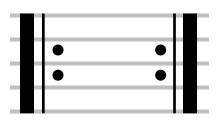 |
Repeat sign means to repeate either from the start of the piece of music or to repeat the notes between two repeat signs |
 |
Double bar line ends the piece of music |
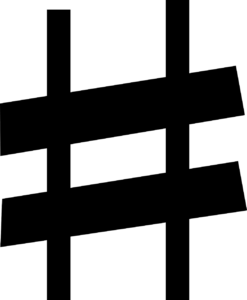 |
A sharp raises the the note up by a semitone (little step or half step) |
 |
A flat lowers the note down by a semitone (little step or half step) |
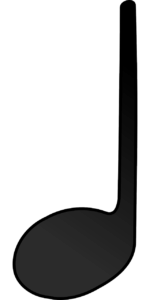 |
Crotchet or quarter note means you hold the note down for one beat. |
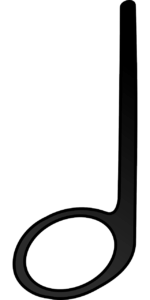 |
Minim or half note means you hold the note down for two beats. |
 |
Dotted minim means you hold the note for three beats |
 |
Semibreve or whole note means you hold the note down for four beats. |
 |
Quaver or eighth notes mean you hold the note down for half a beat. = 1/2 But when you put two halves together you get a whole beat.  = = |
| Example of beats in a bar |  |
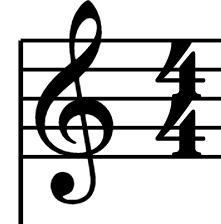 |
Time signature tells you how many beats in a bar and what kind of beats |
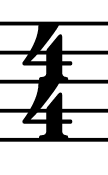 |
Top – How many beats in a bar (4)
Bottom – How the beats are measured (counted in crotchets |
|
Simple Quadruple, 4 crotchet beats per bar |
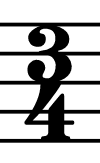 |
Simple triple, 3 crotchet beats per bar |
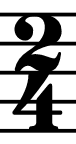 |
Simple Duple, 2 crotchet beats per bar |
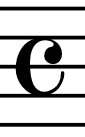 |
Common time, another way of saying 4 beats in a bar. |
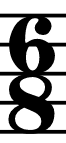 |
Compound Duple, 6 quaver beats in a bar or 2 dotted crotchets. Because 6 is a higher number than 2 or 3 it can be divided by 2.
Instead of counting 1 2 3 4 5 6 it is easier to count to 2 |
| Example of counting |
 |
 |
Staccato dot means to play short and sharp or detached |
 |
An accent means to bring out the note more (play it harder) |
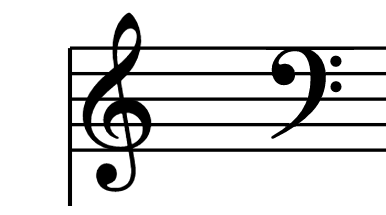 |
The 5 lines and 4 spaces is called a stave. |