
Grade 3 scales
What is the difference between major, harmonic minor and melodic minor?
Major
Major scales have all major or perfect intervals and no matter what the key signature is, it keeps its formation T T S T T T S.
Take your A Major scale for example.

You’ll notice that some are called major intervals, some are perfect. They are called perfect intervals because these CANNOT be made minor, only major intervals can be made minor.
And Speaking of Minor …
You have 2 minor scales.
Harmonic and Melodic Minor
To make a major scale minor in the first place 3 notes must be lowered.
The 3rd, 6th and 7th
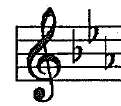
C Minor key signature shows this clearly.
| C Minor | C Major | |
 |
See the difference | 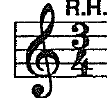 |
| C | D | E | F | G | A | B | C |
| 1 | 2 | 3 | 4 | 5 | 6 | 7 | 8 |
The notes that are circled are all lowered to be come flats for C minor key signature
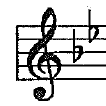
G minor and G major is harder to understand but we can still work it out
| G Minor | G Major | |
 |
Note the difference | 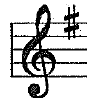 |
As you can see the two look nothing alike but that is because they are different scales.
Remember to go from major to minor 3 notes must be lowered
| G | A | B | C | D | E | F# | G |
| 1 | 2 | 3 | 4 | 5 | 6 | 7 | 8 |
Now as you can see we have B and E in the key signature of G minor, but what do we do with the F#?
Well because it’s the 7th we must lower it.
So how do we lower a sharp?
We make it a  – This is why G minor has no F# in the key signature.
Harmonic Minor
Now to make it a Harmonic Minor we must raise the 7th but still keep the remaining notes minor.

You will see G Minor does the same.

Melodic Minor
Now to make it Melodic minor we need to raise the 6th and 7th when the scale is ascending but when its descending the scale goes back to the key signature.


No Matter what, we keep the minor 3rd. If everything is raised and changed it would be harder to hear that it’s minor.
Chords
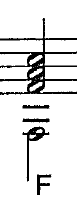
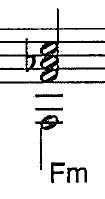
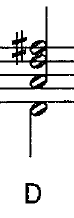
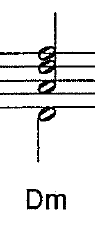
In comparing major and minor chords one very important thing sticks out – They have different accidentals.
This is because they all have the same tonic (root note) and the same 5th but the 3rd is different.
 |
 |
 |
 |
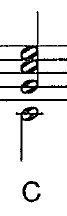 |
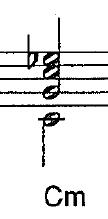 |
|
|
|
|
|
|
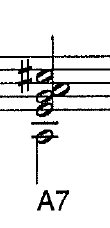
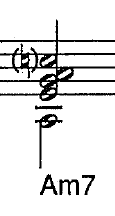
Now you need to compare dominant and minor 7th chords.
These all have the same root, perfect 5th and lowered 7th but again the difference is the 3rd.
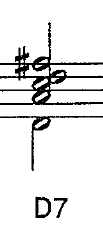 |
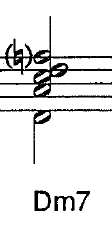 |
 |
 |
|
|
|
|
Key Signatures
Now you have done these in Grade 1 & 2 but lets recap.
Remember to count down 3
C Major – 1 2 3 – A Minor – no sharps or flats
G Major – 1 2 3 – E Minor – 1 sharp F#
F Major – 1 2 3 – D minor – 1 flat B
Now lets add another sharp and flat
D Major – 1 2 3 – B Minor – 2 sharps F# C#
B Major – 1 2 3 – G Minor – 2 flats B E
Count up 5 from G to get to D this is the cycle of 5ths.
| G | A | B | C | D |
| 1 | 2 | 3 | 4 | 5 |
Count up 4 from 4 to get to B this is the cycle of 4ths.
| F | G | H | B |
| 1 | 2 | 3 | 4 |